

Optimización de la selección de pedidos: la guía práctica definitiva para las empresas de comercio electrónico
11/14/2025

In eCommerce, every second counts. Every smooth movement in the warehouse is a promise to your customers: fast, correct, reliable. Slow or faulty order picking costs money, time, and trust. The good news: you can optimize your order picking without blowing up your budget right away.
This guide takes you step by step from pragmatic measures to scalable solutions that truly move growing online shops forward. You’ll learn how to analyze your picking processes using data, improve them in a structured way, and automate them in a targeted manner.
We’ll show you how to increase the pick rate, reduce the error rate, and noticeably lower your order-to-ship time (OTS). The result: shorter delivery times, higher throughput, more customer satisfaction – and more efficient use of your resources across the entire warehouse system.
What is order picking?
Order picking is the central and often most cost-intensive process in logistics. It refers to assembling items from the total warehouse stock according to a specific customer order (the so-called picking list).
In practice this means: identify the item at the storage location, pick it safely, check it, and quickly bring it to outbound (the packing station). The process sounds simple – but every grab, every meter of walking, every second of waiting adds up.
The role of pickers is crucial: they are the link between system and reality. Their actions directly influence speed (order-to-ship time, OTS) as part of the overall throughput time and the error rate of order processing. A well-structured warehouse management setup and suitable picking methods are therefore the key to precise work and stable delivery performance.
Practical tip: when you restructure, document every step of your picking process – from order intake to picking. Only those who make processes visible can improve them in a targeted way.
Why optimized order picking is crucial for your online shop
Efficient order picking is the backbone of every successful eCommerce operation. Fast and accurate deliveries result in better reviews, higher customer loyalty, and fewer returns. At the same time, you reduce your operating costs per order.
The importance of this process is huge: it often accounts for between 50 and 60% of internal logistics costs in the warehouse. Every improvement in your picking processes therefore contributes directly to your success and increases the cost-effectiveness of your entire order fulfillment process.
Example: if you reduce your average picking time from 4 minutes to 3 minutes, you save around 8 working hours per day with 500 orders – the equivalent of a full shift.
Employee motivation also benefits: structured workflows, clear routes, and intuitive systems reduce stress and create reliability. Those who search less and find more work more precisely.
Analysis to identify weak points and optimize order picking
Before you change anything, you need a clear overview of your warehouse. Only those who know where time is being lost can optimize in a targeted way. A data-based analysis helps you recognize the potential in your processes and adjust the right levers.
Start with a time study or a spaghetti diagram: this shows how employees actually move through the warehouse – and where unnecessary walking occurs. Often, small layout mistakes are the biggest bottlenecks.
Which KPIs are relevant for order picking?
Focus on metrics that make productivity, quality, and speed visible:
Pick rate: how many order lines or orders are processed per hour? This figure shows the performance capability of your pickers.
Error rate: how many orders contain incorrect or missing items? Errors can be avoided through structured warehouse management and clear processes.
Throughput time (OTS): how long does it take from order placement to a shipment-ready parcel? This directly determines customer satisfaction.
Cost per pick: a central measure for the efficiency of your order fulfillment process.
Pro tip: complement your metrics with the KPI “picks per square meter of warehouse space.” It shows how efficiently you are using your storage.
The ABC analysis in the warehouse – simple explanation and application
Not all products are the same. With ABC analysis, you categorize your items by turnover frequency to optimize walking distances and storage.
A-items (fast movers): Around 20% of items that generate roughly 80% of your revenue (Pareto principle). Place them in easily accessible locations, as close as possible to the packing station.
B-items: Medium movers with medium demand – stored in the middle warehouse area.
C-items: Slow movers that you can store in a space-saving way and further away.
This categorization forms the basis for efficient picking processes and shorter routes in the warehouse system. Practical tip: update your ABC classification at least once per quarter. Assortments change, and seasonal peaks shift priorities.
Optimizing walking distances in order picking: where are you losing time?
Unnecessary walking is a silent productivity killer. With a clearly structured warehouse organization backed by ABC analysis, you can gain a lot. Create a route-optimized picking list that guides your employees along the shortest path through the warehouse system. Intelligent warehouse management with material flow control or a warehouse management system (WMS) supports planning and ensures precise picking and tracking of your items. This also improves your visibility of inventory.
Additional tip: regularly check whether frequently ordered items are scattered in a zigzag pattern across different rack rows. Simply reorganizing a few hundred products can reduce daily walking distance by several kilometers.
Picking methods compared: which one fits your shop?
Choosing the right picking methods determines speed, flexibility, and efficiency. It depends on product variety, order volume, and your business requirements. Here is an overview of common variants:
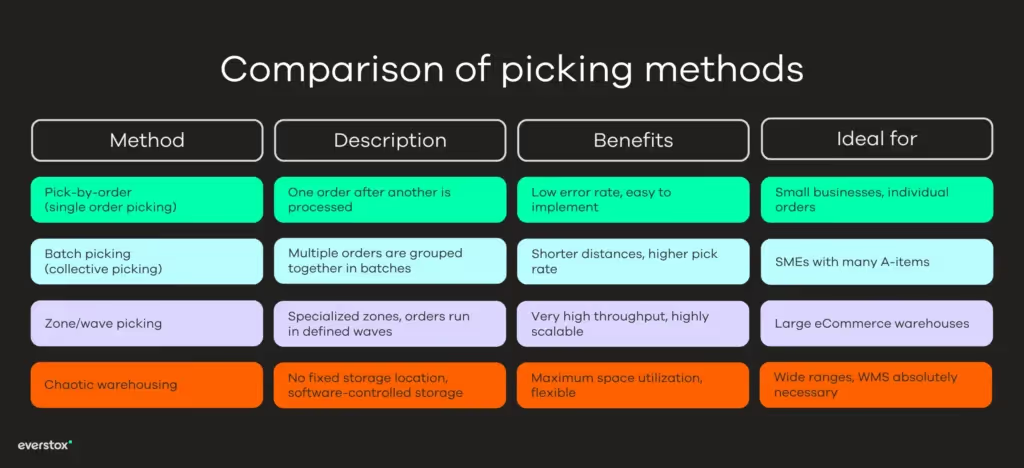
Example: a fashion retailer with 10,000 items achieves 25% shorter picking times by switching from pick-by-order to batch picking – without any structural building changes.
Proven optimization tips for picking (even with a small budget)
Not every improvement requires a new system. Even small structural changes can deliver noticeable results.
Optimizing order picking through better warehouse layouts & ergonomics
A clearly structured warehouse saves time and nerves. Ensure well-planned warehouse layouts, ergonomic gripping heights, and a logical division of storage areas. Training, clear work instructions, and regular process reviews boost motivation and quality.
Practical example: an electronics accessories retailer reduced walking distance per order by 40% through a rearrangement of shelving based on ABC analysis – with the same team size.
How to reduce the error rate – barcodes as a quick win
Errors often arise from incorrect picking, unclear labels, or manual entries. Use:
Scan checks: handheld scanners to verify EAN / UPC codes and location barcodes. The first step toward paperless order picking.
Four-eyes principle: a second check before shipping high-value items.
Standardized labels: uniform descriptions and clearly readable item numbers can reduce errors by up to 70%.
This significantly reduces errors and ensures stable operations in day-to-day business.
The next step: technology & automation
When volume grows, picking systems and software become your strongest levers. They automate routine work and give you control over data, processes, and speed.
What is paperless order picking?
Paper is yesterday. Today, digital systems control the picking process:
Pick-by-scan: Item capture via scanner – high level of verification, ideal for changing assortments.
Pick-by-light: Light signals on the rack indicate the correct location and quantity – ideal for recurring items and high line counts.
Pick-by-voice: Voice-guided commands provide security and speed – perfect for well-trained teams.
Advantage: these systems can save up to 30% time per order and make errors almost impossible when your employees are properly trained.
When is a warehouse management system (WMS) worth it?
A WMS is the control center of your warehouse management. It synchronizes goods receipt, storage, picking, shipping, and transport. Investment pays off when you:
process several hundred orders per day,
have to manage chaotic warehousing or multiple locations,
need real-time data on inventory and processes, or
want to systematically reduce process costs and error rates.
Example: after implementing a WMS, a food eCommerce provider reduced its pick error rate from 1.2% to 0.2% – while doubling order volume at the same time.
What does automation of order picking really cost?
Costs vary widely:
Pick-by-scan: entry-level from a few hundred euros per workstation.
Pick-by-light / robotics: depending on scope, ranges from mid five-figure to low six-figure amounts.
Calculate the ROI of your picking methods carefully. Compare investment costs with savings from lower error rates, faster order assembly, and lower operating costs. Plan in stages – modular integration avoids downtime.
Outsourcing order picking – the ultimate optimization lever (3PL)
If your shop is growing or you need capacity for marketing and customer service, outsourcing your picking processes to a 3PL partner can be a smart move.
Economies of scale: external partners use advanced picking systems such as pick-by-light or pick-by-voice – you benefit without your own investment.
Consistent performance: fulfillment partners achieve consistently high pick rates and very low error rates.
Cost advantage: you convert fixed costs into variable costs and remain flexible in your scaling.
Tip: check whether your 3PL provides real-time access to inventory data. Transparent warehouse management reduces queries and strengthens trust.
Optimizing order picking with everstox
everstox offers modern, scalable solutions for demanding eCommerce logistics. The platform connects your shop/ERP system via standardized API interfaces to a network of high-performance fulfillment centers.
You get real-time tracking, automated status updates, and full control over inventory, orders, and performance. The result: transparent processes, lower operating costs, optimal order assembly, and seamless scalability.
everstox turns your logistics into a true growth driver – with technology that adapts to your needs and partners that can deliver across Europe.
Get in touch now and optimize your pick rates.
Preguntas frecuentes
Which KPIs are most important for order picking?
How do I organize my warehouse for more efficient order picking?
How can I reduce the error rate in order picking most quickly?
What does automation of order picking cost?
Sobre la autora

Anna Kraus
Experta en eCommerce y logística
Con más de siete años de experiencia en marketing online, Anna es responsable de la estrategia de contenidos y el desarrollo editorial del sitio web de everstox. Su trabajo se centra en eCommerce, logística y gestión de la cadena de suministro, traduciendo temas operativos complejos en información clara, relevante y práctica.
Desde su incorporación a everstox en 2024, Anna ha asumido la responsabilidad total del contenido editorial de la empresa, incluyendo artículos de blog, análisis de la industria en profundidad y el glosario completo de everstox. Su contenido conecta las tendencias actuales en eCommerce y logística con los desafíos reales que enfrentan las marcas en crecimiento, ayudando a los tomadores de decisiones a navegar un panorama operativo cada vez más complejo.
Anna tiene una licenciatura de la Universidad de Salzburgo y obtuvo un Máster en Administración de Empresas con especialización en gestión de la salud en la IU International University. Su tesis de máster sobre gestión de la salud ocupacional refleja su mentalidad analítica y su interés en cómo las estrategias integradas pueden fortalecer el rendimiento empresarial a largo plazo.
Combinando rigor académico con experiencia práctica en marketing, Anna ofrece contenido que va más allá del comentario superficial. Su trabajo brinda a los lectores una perspectiva clara y bien fundamentada sobre la intersección entre innovación digital, logística y operaciones de la cadena de suministro, con un fuerte enfoque en la relevancia práctica y la claridad estratégica.
Más artículos interesantes

Fulfillment vs. growth – insights from the abscale podcast
As eCommerce brands grow, fulfillment setups that once worked often start to show their limits.
Not because operations fail - but because complexity increases and the underlying model doesn’t evolve with it.
This is exactly what Johannes Tress discusses in the abscale podcast, and why many fulfillment setups reach a point where they no longer scale.
%20(1704%20x%20960%20px)%20(1).avif)
Logistics out of control? Insights from the UNHYDE podcast
In a recent episode of the UNHYDE podcast, our Co-Founder Johannes Tress shares what actually changes in this phase, and why many eCommerce brands start running into structural challenges long before they realize it.
This article breaks down those patterns and explains where control is typically lost - and what distinguishes setups that scale from those that don’t.

Documentos aduaneros: cómo evitar retrasos y en el comercio internacional
Tu mercancía está empacada, el transportista reservado y el cliente en el extranjero espera su entrega, y de repente todo se detiene. El motivo: el envío queda retenido en el despacho aduanero. Para comerciantes de eCommerce y proveedores de fulfillment, este es el peor escenario posible. Significa retrasos en la entrega, costos de almacenamiento inesperados, sanciones y clientes frustrados.
La buena noticia: muchos de estos riesgos pueden evitarse con procesos claros y documentos aduaneros completos, especialmente cuando toda la documentación requerida está preparada de forma precisa y sin errores.
Esta guía te ofrece una visión práctica de qué documentos son importantes para la exportación, cómo evitar errores en la factura comercial y cómo las declaraciones aduaneras automatizadas hacen que tu crecimiento internacional sea escalable, desde la comprensión de responsabilidades hasta la optimización digital de procesos. Una documentación aduanera impecable es fundamental en cada sección del flujo de trabajo, en cualquier área operativa.